

The European Commission published its review recommendations on 4 May. Here we breakdown everything you need to know ahead of the December 2026 implementation date.
In a nutshell
In this article we analyse the outcome of the review and the changes food businesses need to be applying now to stay EUDR compliant ahead of the 30 December 2026 deadline.
The EU Deforestation Regulation (EUDR) has not had the easiest of rides to implementation. A decade in the making, when it was first tabled the EU’s original vision was designed to curb global deforestation and slash associated greenhouse gas emissions.
That was back in June 2023, with a planned implementation date of December 2024. Fast-forward almost three years and the bill has endured delays, pushbacks and controversy. But on 4 May, the European Commission published an EUDR simplification review, which is a clear signal that finally EUDR will go ahead.
The European Commission published a suite of documents. These covered:
- A set of measures to aid transition
- A report to the Parliament and Council
- Updated guidance
- FAQs
- And a draft Delegated Act on product scope
Here are the outcomes of the simplification review.
Compliance is going to be cheaper for most companies
Here is where simplification has had an impact. Since the regulation’s first iteration compliance costs for companies have dropped by almost 75%. Happy news for the small companies positively affected by the updates.
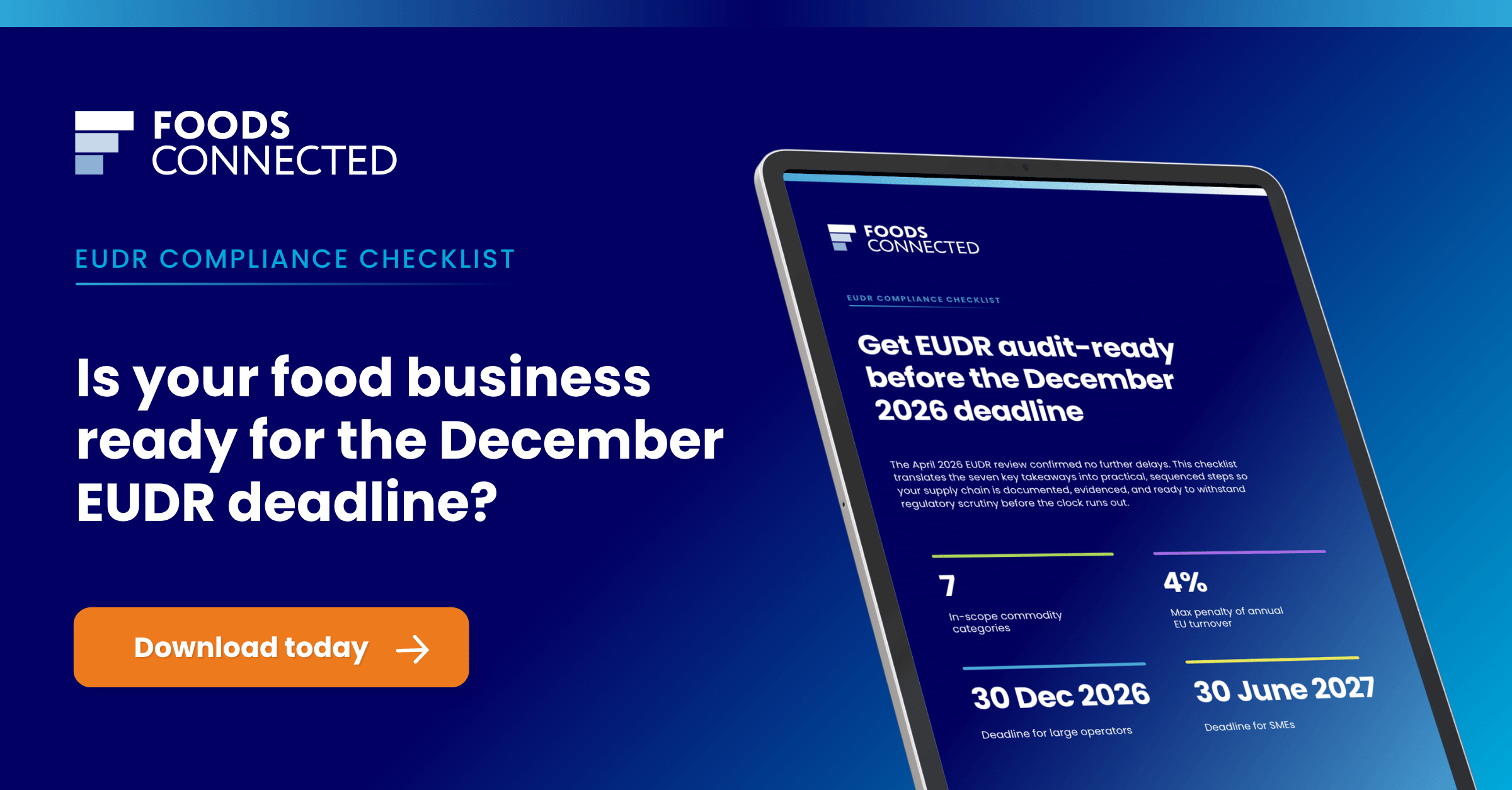
The deadline remains 30 December 2026
It’s the date companies have been tentatively working towards, but now it’s a hard date for the diary. Only smaller companies have a bit more time – their deadline is 30 June 2027.
The core law itself remains unchanged
This might come as a surprise to many considering how divisive EUDR has been in some sectors. But the core legal text remains as it is, but what is changing is the products that fall under EUDR’s scope.
But there are some key changes
The EUDR 2026 draft Delegated Act, published by the European Commission on 4 May 2026 makes the following suggested changes with the hope of removing any exploitation of the current rules by downstream processors. These will be adopted once the consultation period closes on 1 June.
EUDR closes the coffee loop
Previously instant coffee had not been included in the EUDR parameters. The omission was a confusing one, with some experts believing it would lead to issues around products being packaged outside the EU and then imported. That’s now being fixed.
Palm oil derivatives are a new addition
This change would bring oleochemicals – palm-oil based fatty acids, fatty acid methyl esters and palm-oil-derived soaps – under the EUDR umbrella.
This has the capacity to have massive implications for food. Sliced white bread, cakes, confectionery, chocolate, margarines, processed cheese, ice-cream, plant-based burgers, noodles and powdered soups all regularly use palm-oil fatty acids as food additives in recipe formulations.
Manufacturers who haven’t already started reformulating palm oil derivatives out of their products, should consider starting now to avoid this.
Offal is in, leather is out of EUDR
Frozen cattle tongue now joins the list of cattle products included in EUDR (previously only fresh cattle tongue was included – this was flagged as causing potential exploitation issues).
But there is also a new list of suggested new exclusions, which leather tops. Cattle and skins product codes that are looking like they will be removed from scope are:
- raw hides and skins of cattle (HS 4101)
- tanned or curst hides and skins of cattle (HS 4104)
- and leather of cattle, further prepared after tanning or crusting (HS 4107)
The removal is due to the relatively low economic value of cattle skins and hides compared to meat within the overall cattle production, which makes it hard for retailers to ensure their suppliers are compliant.
Product samples also join the exclusion list, due to the fact that these items are “either completely used up or destroyed in the course of the examination, analysis or testing”.
Other non-food stuffs excluded include books, retreaded tyres and second-hand items.
Why all these changes? Trade, environmental and economic data and to reduce the number of unique importing operators from 352,000 to 275,000.
The three existing tiers remain as they are
There was a lot of lobbying - from the US in particular – for the addition of a “negligible” or “no risk” category. This isn’t happening. But a new category of micro or small primary operators has been introduced and only applies to operators in countries classified as low risk. Any businesses that fall into this category only need to submit a one-off simplified declaration then share the declaration identifier to downstream operators or traders.
Responsibility does shift to a first operator model
Previously every actor that touched a product in a supply chain (excluding SMEs) had to file a due diligence statement. The simplification report shifts this to either the first operator who places the product on the EU market or the one who exports it.
This means downstream operators and traders now take a more passive role. They only have to register in the EUDR information system if they are the next step in the supply chain after the operator in order to share the due diligence statement reference numbers.
The updated FAQs address some of the big questions
Food industry professional looking for clarity around the hows and whos of EUDR can hopefully now find them in the updated frequently asked questions and guidance doc.
Issues addressed include:
- Multiple shipments under a single due diligence statement
- How forest associations can submit info on behalf of individual forest owners
- the obligations of downstream operators, confirming their role is limited to passive collection
- And the possibility of a company being both an importer and a producer
What happens next?
Once the consultation window closes on 1 June these amendments will be accepted and the EUDR IT system will reopen with the updates. There will also be a new feature – companies will be able to submit group submissions.
Food businesses need to be acting now to get compliant ahead of the 30 December 2026. You can read more about all the EUDR requirements and what your business needs to do to get regulation ready by downloading our checklist here.
.jpg)
Greer McNally
Greer has over 15 years’ experience writing about trends in the food and retail sectors. She lives in a little village by the sea in Northern Ireland and loves creating content that informs how people think about the food industry. A recent career highlight was interviewing the legend that is Dr Temple Grandin.
-1.png "Protein Procurement What You Cant See, What Its Costing, and How to Fix It (1)-1")
Browse Posts
/Blog%20Headers/shutterstock_1927957907%20(1).jpg)
/Blog%20Headers/shutterstock_2474442759.jpg)
/Blog%20Headers/shutterstock_1845178195%20(2).jpg)
/Blog%20Headers/shutterstock_2133827717%20(1).jpg)



- October 2026
- September 2026
- August 2026
- July 2026
- June 2026
- May 2026
- April 2026
- March 2026
- February 2026
- January 2026
- December 2025
- November 2025
- October 2025
- September 2025
- August 2025
- July 2025
- June 2025
- May 2025
- April 2025
- March 2025
- February 2025
- January 2025
- December 2024
- November 2024
- October 2024
- September 2024
- August 2024
- July 2024
- June 2024
- May 2024
- April 2024
- March 2024
- February 2024
- January 2024
- December 2023
- November 2023
- October 2023
- September 2023
- August 2023
- July 2023
- June 2023
- May 2023
- April 2023
- March 2023
- December 2022
- November 2022
.png)
.png)

.png)
.png)
.png)
.png)

.png)