
In a nutshell
- 2026 will be a defining year for the US beef industry
- Tight cattle supply, sustained cost pressure, shifting trade dynamics and increasingly price-sensitive consumers are converging at the same time
- For processors, margin protection will depend on carcass optimisation, disciplined export strategies and clear protein positioning
- For retailers, the meat case is no longer an operational decision but a strategic one - balancing availability, promotion discipline and consumer trust
If “business as usual” is your mantra, then you are likely to have a rough 2026. So says Hyrum Egbert, protein expert and author of The Big Bad Beef Packer newsletter, as he reveals why this year will be a defining time for processors and retailers in the US beef industry.
So why do I think 2026 is going to be rough for those with a “business as usual” mantra? It's not because anyone forgot how to run a plant or a meat case, but because the pressure points are now synchronised. The processor is squeezed by cattle supply, rising operating costs, and an export environment that is getting more competitive. The retailer is squeezed by food inflation fatigue, tighter beef availability, and the consumer’s ongoing math problem: “I want it, but can I afford it?”
And here is the part that makes 2026 different. These are not independent problems. They cascade.
When cattle is tight, live prices stay elevated. When live prices stay elevated, wholesale stays elevated. When wholesale stays elevated, retail gets sticker shock. When retail sticker shock becomes too much to stomach, the basket changes. When the basket changes, the carcass becomes harder to clear. When the carcass is harder to clear, the processor gets even more disciplined about what it bids for cattle. The loop tightens.
So, let’s call 2026 what it is shaping up to be in the US beef market: a year where processors and retailers either (a) coordinate like supply chain partners, or (b) fight like adversaries and both bleed margin.
The 2026 backdrop: less cattle, more expensive beef and a consumer that is fatigued
Let's start with the physical reality: the US cattle herd is smaller than it has been in decades, and the liquidation phase has not magically reversed. As of January 1, 2025, the US had 86.7 million head of cattle and calves, including 27.9 million beef cows. That herd is down meaningfully from the 2019 peak (94.7 million head). Expect that number to drop further when USDA publishes its numbers for 2026.
"Let's start with the physical reality: the US cattle herd is smaller than it has been in decades, and the liquidation phase has not magically reversed.
Then look at the near-term pipeline. On December 1, 2025, cattle on feed in feedlots with capacity of 1,000+ head totalled about 11.7 million head, down 2% year over year. In the USDA Economic Research Service’s (ERS) January 2026 outlook, November 2025 net placements were reported down over 11% year-over-year. That matters, because placements today are marketings tomorrow.
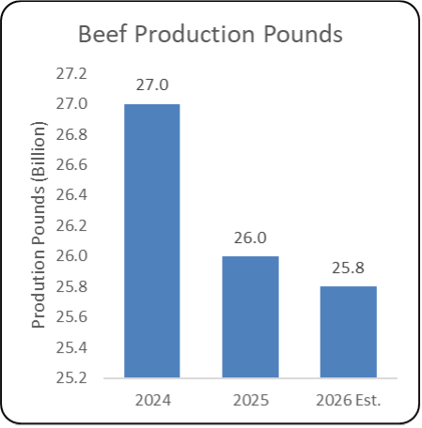
ERS is already projecting 2026 commercial beef production at 25.8 billion pounds, down from 26.0 billion pounds in 2025. At the same time, ERS raised its 2026 fed cattle price forecast to $235.75/cwt and feeder steers (750–800 lb) to $357/cwt. Translation: fewer pounds, at higher input costs, with very little room for operational sloppiness.
Now layer in the consumer. By December 2025, CPI data showed beef and veal up 16.4% year over year, with uncooked ground beef up 15.5% and uncooked beef steaks up 17.8%. That is not a rounding error in the meat department. It is a behavioural nudge. You can “trade down” only so many times before you start “trading out.”
Meanwhile, ERS expects overall food inflation to cool in 2026 at the macro level (midpoint forecasts: all food +2.7%, food-at-home +2.3%, food-away-from-home +3.3%). But cooling inflation does not automatically mean cheap beef. Beef has its own physics, and that physics is the cattle cycle plus trade flows plus demand elasticity.
Trade will not be a footnote in 2026. It will be a lever
For processors, exports can be the profit pressure relief valve, until they are not.
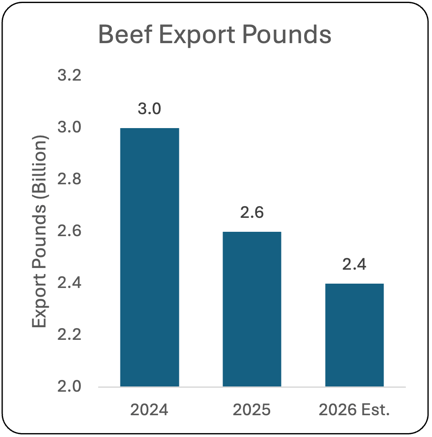 ERS’s January 2026 outlook pegs 2025 US beef exports at 2.6 billion pounds, then forecasts 2026 exports at 2.4 billion pounds, explicitly citing tougher competition in key Asian markets. If you are a processor counting on exports to clear a specific chunk of the carcass at a premium, a softer export year is not an academic scenario. It changes your break-even on the animal.
For retailers, imports are the stabiliser, until policy or global flows make them less stabilising.
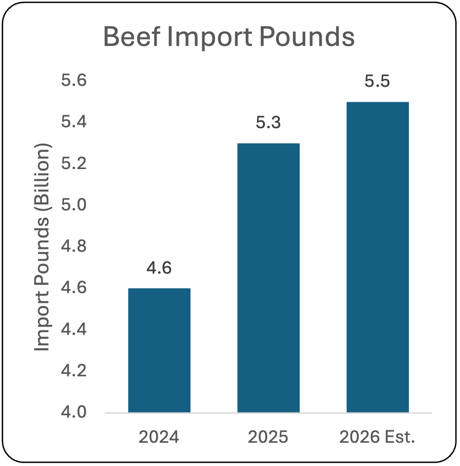
ERS forecasts 2025 US beef imports at 5.4 billion pounds and 2026 imports at 5.5 billion pounds, up year-over-year. That helps, especially for lean beef inputs that influence ground beef economics. But import availability is not just “demand pull.” It is also policy shape. For example, ERS notes that as of January 1, 2026, the US tariff-rate quota “Other” category decreased to 52,005 metric tons and a new UK quota of 13,000 metric tons was established. Policy moves like these are not always the main story, but they can be the difference between “ground beef finally cooled off” and “why is grind still at record levels?”
The key point for 2026 Trade: processors are exposed on exports, retailers are exposed on imports, and both are exposed to the second-order effects of global rerouting (where product that cannot go to Market A shows up in Market B).
The processor problem in 2026: expensive cattle, unforgiving operating leverage and less room for error
When cattle costs rise faster than you can push value through the carcass, you get margin compression. When you run below efficient scale, you get margin compression plus cash burn. When exports soften, you get carcass imbalance.
 So, what does “profitability” look like for processors in 2026?
Processor playbook: 3 steps to protect profitability (and your balance sheet)
Step 1: Define your protein strategy, then defend it
If you are trying to be everything to everyone, 2026 will punish you. Your strategy has to show up in the animal, the specs, the claims, and the customer promise. That could mean commodity scale done exceptionally well, or it could mean a differentiated program that justifies a more predictable margin structure. The point is not “premium.” The point is “intentional.” In a year where fed cattle prices are forecast to remain historically strong, you cannot afford a vague value proposition.
Step 2: Shift from volume alone to scalable volume plus carcass optimisation
A smaller herd and lower production forecasts mean you will not “throughput” your way out of mediocre utilisation. The win is getting more value out of the same animal, consistently.
That means:
- Tighter fabrication discipline to protect yield capture
- Product mix decisions that reduce “forced discounting”
- Turning waste streams into revenue streams (tallow, broth inputs, jerky, pet treats, and bones
If you treat by-products as “found money,” you will manage them like “found money.” In 2026, they need to be managed like a portfolio.
Step 3: Develop export partnerships directly, not just through brokers
Exports are forecasted lower in 2026. That does not mean “give up.” It means you should fight for fewer, higher-quality export relationships where you can align specifications, volumes and pricing frameworks.
The goal is not to eliminate brokers. The goal is to reduce your dependence on a spotty channel when you need predictable demand pull for specific primals and variety meats.
The retailer problem in 2026: the meat case is now a strategy decision, not a department decision
Retailers have a different but equally sharp challenge: you are trying to protect traffic and loyalty while beef remains expensive, and consumers are increasingly promotion-conditioned.
CPI tells you the consumer is already feeling it. Beef inflation in the mid-teens year over year is exactly where shoppers start to change behavior.
Retailers also face a quieter operational risk: supply assurance. When supplies tighten, out-of-stocks rise, substitutions increase, and customer trust erodes. In 2026, availability is not just an ops KPI, it is a brand KPI.
"In 2026, availability is not just an ops KPI, it is a brand KPI.
Retailer playbook: 3 steps to protect promo lift without sacrificing margin
Step 1: Decide what you want the meat case to be
Are you going to be the lowest cost provider operator, protecting perception even if margin narrows? Or are you going to build a program that creates value, even if it means fewer total beef pounds sold? There is no universal right answer. There is only the wrong answer: trying to do both at once without a coherent plan.
Step 2: Assure supply and reduce stockouts
In a tighter supply environment, procurement and replenishment discipline becomes a competitive advantage. This is where retailers benefit from deeper collaboration with processors on:
- Forward commitments where appropriate
- Realistic lead times
- Substitutable product ladders (so the consumer still buys protein, even when a specific item is tight)
ERS’s production outlook is already pointing to fewer pounds in 2026. Retailers that treat supply assurance as “someone else’s job” will pay for it in empty shelf space and broken promos.
Step 3: Treat promo planning as a supply chain process, not a marketing calendar
When beef is expensive and consumers are promotion-responsive, promo discipline matters more than ever. But a bad promo is worse than no promo. It creates demand you cannot fulfill, or it forces margin destruction at exactly the wrong time.
The best retailers will move promo planning upstream, aligning with processors on:
- Ad schedules that match production realities
- Item selection that supports carcass balance (helping processors avoid dumping product)
- Promo designs that drive lift without crushing margin
The uncomfortable truth: processors and retailers are going to rise or fall together in 2026
Processors can complain that retailers "won’t take the price". Retailers can complain that processors "won’t hold the price". Both can be right in the moment, and both can lose across the year.
A smarter framing for 2026 is: How do we reduce volatility and protect profitability on both sides of the handoff?
Here are three shared moves that matter more than they sound:
- Co-plan the carcass, not just the box: Retailers influence carcass balance through item selection and promo emphasis. Processors live and die by carcass balance. In a year of tight cattle and elevated prices, balance is not optional.
- Build “value ladders” that keep consumers in protein: Beef should remain the anchor where it earns its keep, but retailers should actively merchandise the trade-down path: steak to roast, roast to grind, grind to blended options, and when appropriate, beef to pork or chicken for price-point protection. CPI already shows other proteins are not inflating at the same rate as beef (for example, chicken inflation was far lower than beef in December 2025). That spread is a tool, not a threat.
- Treat trade as a strategy input, not a surprise: Processors should proactively manage export exposure as competition rises. Retailers should proactively manage imported beef exposure, and understand how policy changes and global flows can alter availability.
Closing thought
2026 is not shaping up to be a year where “good operators” win and “bad operators” lose. It is shaping up to be a year where intentional operators win together, and everyone else explains away results with the cattle cycle.
Processors: define the strategy, optimise the carcass, professionalise exports, and manage the animal as the unit of profit.
Retailers: decide what the meat case stands for, secure supply, and make promos a coordinated plan, not a wish.
Because in 2026, strategic pivots with trusted partners will be the difference between success and failure.

Hyrum Egbert
Hyrum Egbert specialises in turning around underperforming organisations—rapidly and sustainably. With a career rooted in the protein and manufacturing industries, he has led cross-functional transformations that realign culture, restore profitability, and create lasting enterprise value. He is also the author the biweekly The Big Bad Beef Packer newsletter.
-1.png "Protein Procurement What You Cant See, What Its Costing, and How to Fix It (1)-1")
Browse Posts
/Blog%20Headers/shutterstock_1927957907%20(1).jpg)
/Blog%20Headers/shutterstock_2474442759.jpg)
/Blog%20Headers/shutterstock_1845178195%20(2).jpg)
/Blog%20Headers/shutterstock_2133827717%20(1).jpg)




- October 2026
- September 2026
- August 2026
- July 2026
- June 2026
- May 2026
- April 2026
- March 2026
- February 2026
- January 2026
- December 2025
- November 2025
- October 2025
- September 2025
- August 2025
- July 2025
- June 2025
- May 2025
- April 2025
- March 2025
- February 2025
- January 2025
- December 2024
- November 2024
- October 2024
- September 2024
- August 2024
- July 2024
- June 2024
- May 2024
- April 2024
- March 2024
- February 2024
- January 2024
- December 2023
- November 2023
- October 2023
- September 2023
- August 2023
- July 2023
- June 2023
- May 2023
- April 2023
- March 2023
- December 2022
- November 2022
/Blog%20Headers/Blog%20header_How%20AI%20is%20making%20supply%20chains%20more%20efficient.jpg)
-1.png)
/Blog%20Headers/New%20Calorie%20Labelling%20Regulations%20in%20England%20What%20Will%20it%20Mean%20for%20your%20Business.jpg)

.jpg)
/Blog%20Headers/Duncan%20Spencer%20Brown.png)