
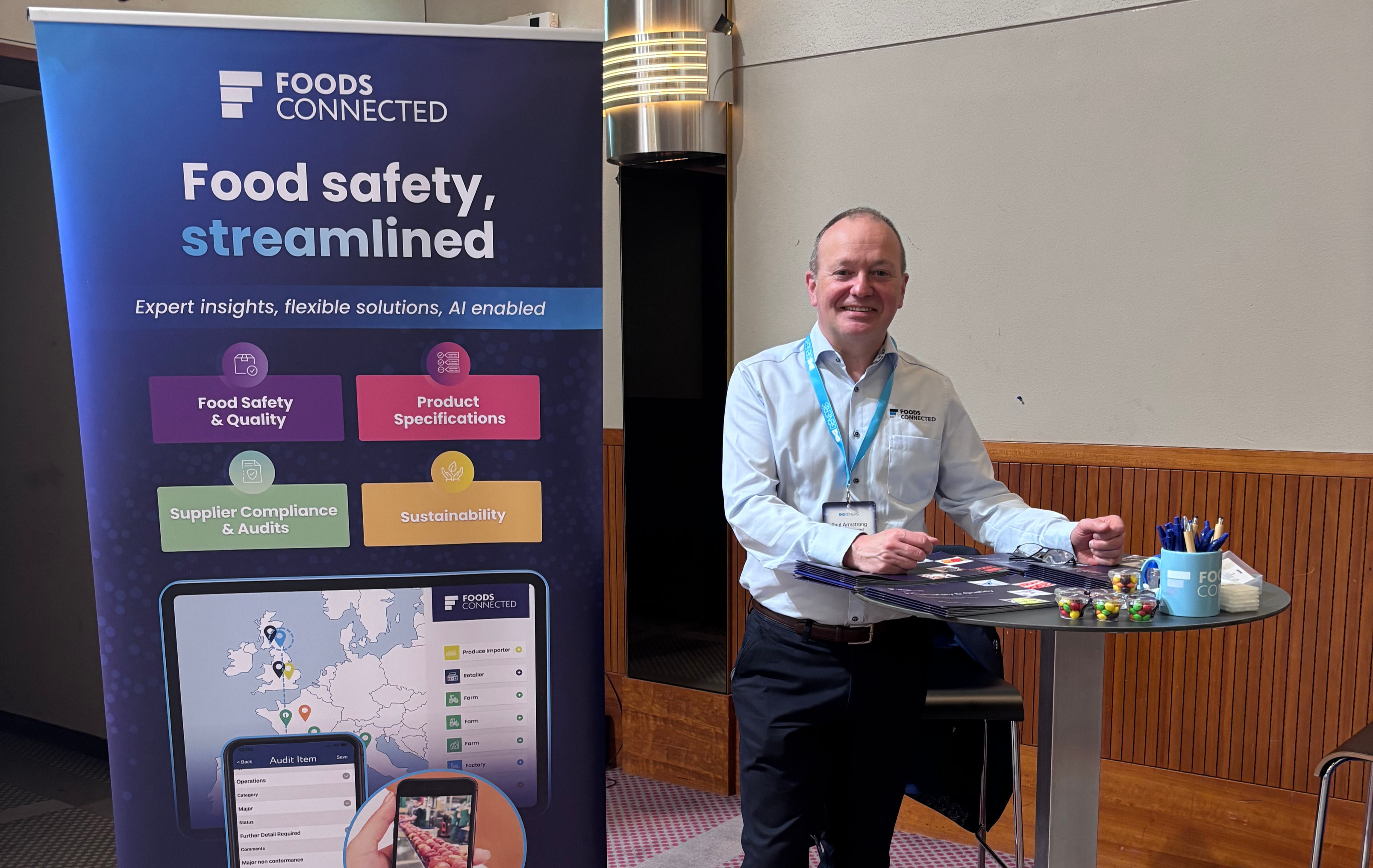
The Foods Connected Chief Sales Officer and Co-founder shares his thoughts on AI, the biggest challenges the sector is facing in 2026 and reveals how the brand went from an idea to a reality.
We'll jump straight in. What was it that drew you to the food industry?
I got into it by accident really. I did business studies and languages at university, studied in France for a year and then worked in Madrid too. When I graduated I wasn't sure which direction to go in – and then I got a graduate placement job with a local meat company, who based in Coleraine.
They were looking for somebody to help export their meat to France and Spain. With my background it was a pretty good starting point. Little did I know that for the first three months I was going to be down on the shop floor, loading lorries and cutting meat. It was a great education. My boss was brilliant – very hands on and keen for me to learn.
From there, I went to my next company, a leading meat processor in Northern Ireland, where I stayed for 27 and a half years. I started out very junior in sales and then worked my way up, running a couple of the factories before becoming Commercial Director. All that experience over the years helped me to identify an opportunity with software, which is what I'm doing today in Foods Connected.
That very first job on the shop floor must have been a steep learning curve, but you found a passion for food quickly?
One thing I'd say about the food industry – or the meat industry, because that's where my major expertise is – is that no two days are ever the same. Prices rise and fall almost on a daily basis. So you could never sit back and rest on your laurels. .
You might be away in Paris visiting a customer one week, then the next you're spending time on the shop floor starting a new job for a client and staying close to the product. You really had to be on the market. The range of activities means that you never get bored with the day to day. And I suppose that variety appealed to me, particularly in the early part of my career when I was trying to figure out what I really enjoy doing.
As I moved up within the organisation, I had more people responsibility and enjoyed that side of the business, particularly mentoring young people similar to myself sort of five years previous. Coming in and being able to help them with their own careers was really rewarding. A lot of those people I'm still in touch with and remain good friends with today. In fact in some cases, I've actually employed them at Foods Connected.
So where did the idea for Foods Connected come from?
I'd had a couple of lightbulb moments when I was running factories. One of the big quality KPI criteria for meat was (and is) the temperature of meat.
When you slaughter an animal it starts off at 36 or 37 degrees and comes down in temperature over a couple of days. Best practice would say the closer you get to zero before you de-bone, the better the colour will be, the better the micro, the shelf life – all that good stuff that the consumer really likes at the end of the day.
So I started measuring the temperature of every beef quarter going into the boning hall. But the only way to do that was to probe every carcass. Now bear in mind, we're doing maybe a thousand quarters a day. That's a lot of probing – and it was all done by one guy. He was writing down the temperatures as the quarters were going in and then we'd have a morning meeting with all the key factory management personnel to talk about the day ahead and any of the pain points.
"I'd had a couple of kind of lightbulb moments, particularly when I was running factories.
The data from the boning hall was always on A4 sheets of paper covered in blood and I thought to myself, number one, it's a bit of a mess. There's bound to be a better, cleaner way of doing this. Number two, I couldn't get any insight from the data. Yes, I could see whether the quarters were at the right temperature and take action that way, but it was all a bit manual and admin heavy and didn't give me the insight.
I had an instinct that software, used properly within the meat industry, could start to give us those insights and really help drive improvements in quality, productivity and yield. So, I set up this program in Excel to sell and market meat better. I affectionately called it SAMMI, which stood for Sales and Meat Marketing Information. It was end-to-end – all my costings were in there, the product specifications etc – and my customers and I used it as a single source of truth.
It got me thinking about software and how it could work better outside of an Excel package. I realised it would have to be built specifically for the food industry.
So how did it go from an idea to a reality?
I noodled the idea in my head for quite a number of years, but wasn't brave enough to do anything about it. I had three young children at the time. I approached my boss with the idea – the company's board of directors liked it but wanted to keep me and so said no to the investing. Then Roger [McCracken, Foods Connected's CEO and Co-founder] came to work for me and I got talking about the opportunity.
"I set up this program in Excel to sell and market meat better. .. It was end-to-end – all my costings were in there, the product specifications etc – and my customers and I used it as a single source of truth.
He had just come out of Bath University and had already tried to set up a graduate-orientated business called the Grad Room. But, he wasn't able to get it off the ground. We'd be sitting together after a long day in the office and think about how we could develop our idea. Eventually we decided to take the leap. It started out as Meat@Work and then evolved into Meat Connected. Then we quickly pivoted to Foods Connected when we realised there was an opportunity in the broader food sector.
Our CTO and Co-founder, Gary Tyre, came into the picture, because I worked with his uncle. He was 16 and looking for holiday work. We had him up in the factory doing all the typical student jobs, packing meat, sweeping up etc, but then somebody said he was really good on computers – and I needed a health and safety platform for the meat factory. So I asked Gary to build it. Within four to six weeks, he had put in place a really good system, where we could record accidents, start to build trends, all that sort of stuff.
But we didn't go to Gary then. When we first set up the business, Roger and I actually went through the Yellow Pages looking for software companies in Belfast. We landed on one we thought we were going to work with, and tried and failed over a 6-8 month period to get something up and running, spending money that we probably didn't have.
We eventually decided it wasn't going to work and I genuinely thought we were going to call it quits. I remember walking down the Dublin Road in Belfast saying to Roger "I suppose that's it. But if you'd like one last throw of the dice, there's a guy who used to work for me at Foyle Meats. He's a nephew of a good friend of mine. He's good at computers. Would you talk to him?"
"We eventually decided it wasn't going to work and I genuinely thought we were going to call it quits. I remember walking down the Dublin Road in Belfast saying to Roger "I suppose that's it."
I fully expected Roger to say, no, we've blown enough money, best of luck and enjoy the rest of your life. But Roger being Roger, said let's go for it. I put the two guys in touch and they immediately clicked. Within a very short period of time, we had a very minimal viable product and Roger went out and started talking to potential clients – and that was basically how we built the business.
I was still in the background, working in the meat industry. Roger and I made a pact that I wouldn't compromise myself with any data, so I wasn't able to see it. But at the same time, I was advising him on the best trade shows to go to and developments in the industry. So, that's basically how we got the business set up.
What are the biggest challenges the industry is facing right now?
Right now it's turbulence in the market. At a macro level, there's climate change impacting supply chains in a very significant way. Look at the price of cocoa – it's gone mad at certain times over the past year. Beef prices have gone really high globally. Then, there's environmental issues like African Swine Fever in Spain, which had a massive knock-on effect in a negative way.
All these events create an air of uncertainty, making it more complex and more difficult to manage. Where we can help is with supply chain visibility and resilience. We can go into markets and introduce new suppliers and supply chains, helping businesses manage the turbulence.
Another massive issue is the shortage of skills. There's been a real erosion particularly in senior and middle management. Once upon a time a typical retailer or big QSR would have experts with loads of experience. Now you might have a meat buyer, who might have been buying toilet roll the week before and eggs a month before that. That leads to a lot of fresh-faced graduates coming in and that don't have anyone to mentor them.
"Once upon a time a typical retailer or big QSR would have experts with loads of experience. Now you might have a meat buyer, who might have been buying toilet roll the week before.
That erosion of skills is putting businesses under an awful lot of pressure and making life more difficult for them. I think the solution is for businesses to create graduate schemes that allow young people the time to go around and learn the different parts of the business. There's so much of a focus on costs and being efficient that businesses expect people to come in and just start from day one.
What pain points are Foods Connected targeting for customers?
I think the biggest pain point is data – data here, data there, data everywhere across multiple systems. People have one system for product specs, one for procurement, and another for sustainability. Basically that means the data ends up siloed, making it difficult for clients to see the big picture.
What we're trying to do at Foods Connected is create a single source of truth – that end-to-end piece where a client just logs on once to access everything. With us there's one point of contact, one lot of training, one cost and full end-to-end visibility of not only their supply chain, but in some cases their own internal operations too.
"I think the biggest pain point is data – data here, data there, data everywhere across multiple systems.
I spoke to a client recently and they had one person full time just looking after all their supplier data. So that meant emailing suppliers, asking them to send their BRC search, just keeping on top of the whole supply chain. So the admin piece is another pertinent pain point. We automate that whole process.
Then, if you look at our strategic sourcing and protein optimise solutions, there's a real element of helping businesses manage their costs. We've done a lot of work with large retailers, optimising their meat supply chain so they can be sure that they're not overpaying for product. We've had some really strong success stories in the protein space, where the commodity prices of beef and lamb have literally doubled over the last 10 years.
If you take all of those things together, ultimately what we're about is managing risk. The risk of the cost of goods, the risk of non-compliance, the risk of food safety events. Ultimately we're trying to help businesses manage risk and build resilience through our software. In other words, the software is the enabler for the solution.
If you had to choose three things that you recommend businesses should be doing to stay competitive in 2026, what would they be?
Number one – understand your supply chain in terms of the cost of all the raw materials that feed into your finished products. Use a third-party company like Foods Connected to help you understand and identify other opportunities for supply in that business. That alone will help businesses be competitive and make all the costing data more transparent.
"Ultimately we're trying to help businesses manage risk and build resilience through our software. In other words, the software is the enabler for the solution.
The second thing is to reduce your admin. Having somebody filling out spreadsheets or Word documents is such a time sink. You can do it all in real time using a software platform.
Thirdly, empower your young people through training. It might not give you an immediate benefit in 2026, in fact it's probably going to be a cost, but it's going to make your business more sustainable in the future. So they would be probably my top three at the moment.
AI is obviously a big talking point right now. How do you see it shaping the future of food?
I mean I think AI will never grow tomatoes. But what I do think it will teach us is how to produce food a lot more efficiently. That might be through improving food management practices, the automation of factory floor processes, or extra visibility of supply chains and procurement. It will help us do things more efficiently and better. There's a lot of doomsday scenarios – and I'm sure AI will lead to some streamlining, but it has the potential to create a world where life is easier for people.
I see AI helping us understand the whole ultra-processed food market better. We're going to look back in 25 or 30 years and look at UPFs the way we look at cigarettes today. I think it will be an opportunity to actually improve the quality of food and therefore improve people's health as a result.
"I see AI helping us understand the whole ultra-processed food market better. We're going to look back in 25 or 30 years and look at UPFs the way we look at cigarettes today.
Obviously from an internal viewpoint, we're harnessing AI across our current software and our upcoming recipe and supplier intelligence tools. Being able to put a supplier name in and get the data on the financial stability of the company, any quality or reputational risk, the products that they do, the management team, plus any news stories in just a matter of minutes is a fantastic asset. You would have to spend a day researching that previously. Roger describes it best, AI is a "force multiplier", speeding up all the benefits you get from the data that we produce.
And as we enter Q4, what are your plans for 2026?
I see great things ahead for the Sales team this year. We've got some brilliant people – Mike McCarthy, James Hennessy, Kyle Anderson, Chris Nichols, Ian Collins, and then Hannah Sharkey and her team of sales engineers.
I think my year is going to involve quite a lot of getting out there, a lot of travel, a lot of going and meeting customers face to face and always innovating with our approach. I'll be in Chicago with the team and meeting Chris Nichols, who came on board recently. Plus, I'm planning a trip down to Australia to spend a bit of time with James Hennessey on the market.
Basically, we can never stand still. We have to think is there some better way of doing it? So, I think for me 2026 is about staying curious and embracing the opportunities the year ahead brings.
Overcome your food safety challenges with our Digital Food Safety and Quality Management tools. To learn more, download your free brochure:

.jpg)
Greer McNally
Greer has over 15 years’ experience writing about trends in the food and retail sectors. She lives in a little village by the sea in Northern Ireland and loves creating content that informs how people think about the food industry. A recent career highlight was interviewing the legend that is Dr Temple Grandin.
.png "Protein Procurement What You Cant See, What Its Costing, and How to Fix It (7)")
Browse Posts
/Blog%20Headers/shutterstock_1927957907%20(1).jpg)
/Blog%20Headers/shutterstock_2474442759.jpg)
/Blog%20Headers/shutterstock_1845178195%20(2).jpg)
/Blog%20Headers/shutterstock_2133827717%20(1).jpg)


- October 2026
- September 2026
- August 2026
- July 2026
- June 2026
- May 2026
- April 2026
- March 2026
- February 2026
- January 2026
- December 2025
- November 2025
- October 2025
- September 2025
- August 2025
- July 2025
- June 2025
- May 2025
- April 2025
- March 2025
- February 2025
- January 2025
- December 2024
- November 2024
- October 2024
- September 2024
- August 2024
- July 2024
- June 2024
- May 2024
- April 2024
- March 2024
- February 2024
- January 2024
- December 2023
- November 2023
- October 2023
- September 2023
- August 2023
- July 2023
- June 2023
- May 2023
- April 2023
- March 2023
- December 2022
/1.%20HubSpot%20Images/AdobeStock_444686342.jpeg)
/Blog%20Headers/shutterstock_1313461523.jpg)
/Blog%20Headers/NPD_screen%20and%20test-1.jpg)
.png)
/1.%20HubSpot%20Images/Roger%20New%201a%20(1)%20(1).jpg)
.png)
.png)