Food manufacturers are under constant pressure to launch, reformulate and extend their ranges, yet many are still managing the product data behind that work with tools never designed for the job. That gap is the real state of PLM in food manufacturing today. It's also the opportunity for senior leaders in food manufacturing who want to move faster without adding risk.
Here, we cover:
- What PLM means in food manufacturing
- Why innovation puts product data under strain
- What the US reformulation wave reveals
- Where the industry's digital progress actually stands
- Why general-purpose PLM often fits food badly
- What the next phase of PLM looks like
What is PLM in food manufacturing?
Product lifecycle management (PLM) in food manufacturing is the practice of managing a product's formulation, specification, ingredient and supplier data, labelling and approvals as one connected record, from first concept through launch and every change after it. It differs from PLM in other industries because food products are defined by recipes, allergens and ingredient data that come from suppliers and change often, rather than by parts and drawings.
Innovation puts product data under strain because most launches don't last
New products are hard to land. A McKinsey analysis cited in FoodNavigator found that only 25 per cent of new brands and disruptive innovations from large packaged food companies are still on shelf four years later.
That has a direct effect on product data. A business that launches, tests, adjusts and reformulates repeatedly creates a steady stream of specifications, formulation changes and label updates. Each one has to be recorded, approved and kept consistent across teams, suppliers and customers. The more a manufacturer innovates, the more its product records are put under pressure.
The US reformulation wave shows how quickly product data becomes the bottleneck
The United States offers a live example. The FDA's public tracker of industry pledges to remove petroleum-based food dyes listed 32 pledges from 31 organisations as of 16 October 2026, with 12 marked complete and 20 in progress. Company targets run from summer 2026 to December 2028.
Each pledge sits on top of a long chain of product data. Removing one colour means finding a replacement ingredient, qualifying the supplier, updating the formulation, rechecking allergen and labelling information, and repeating the work across every product that uses it. Trade press has also raised the prospect of a patchwork of state ingredient laws, and FoodNavigator reports that supplier verification and new specifications need to start early to avoid sourcing delays.
Whatever the trigger, the manufacturers that adapt quickest are the ones whose product records show what's in each product, who supplies it, and what changes if an ingredient does.
Every specification on one version-controlled record.
Shared live with suppliers and internal teams, so everyone works from the current version.
Download now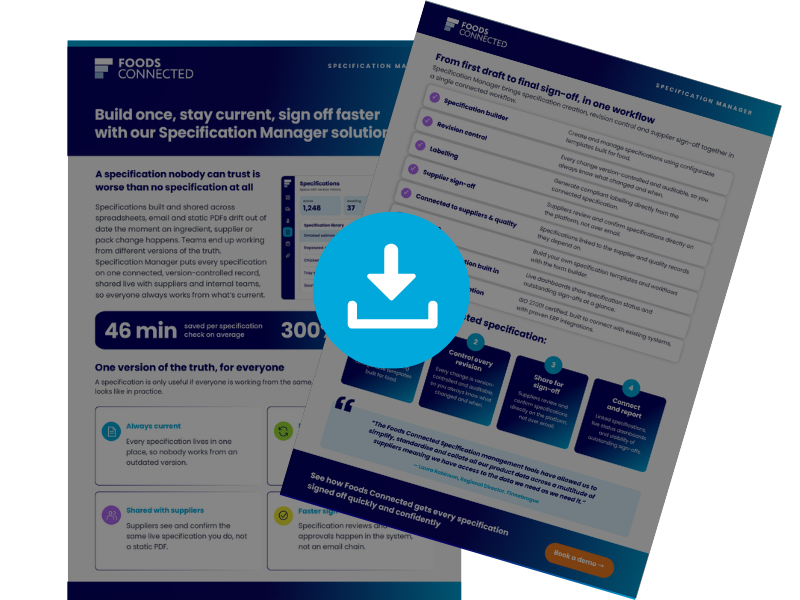
The industry's digital progress is real, but uneven
Independent figures on PLM adoption specifically in food are scarce, which is telling in itself. Broader research gives a useful picture. MindMetre's study of more than 1,000 manufacturers worldwide cited earlier work putting adoption of significant digital transformation at 25 to 30 per cent in 2023-24, and named managing and using data as one of four factors slowing progress. That research covers manufacturing generally, not just food.
The Food and Drink Federation's Future Factory report found senior leaders in UK food and drink manufacturing enthusiastic about digital, AI and automation, but struggling to implement them. It identified integrating legacy systems with modern solutions as one of the main obstacles.
Taken together, the picture is of an industry that wants to digitise and finds the practical steps harder than expected, with product data among the hardest parts.
Why does general-purpose PLM struggle in food manufacturing?
Food products behave differently from most manufactured goods. A recipe is a living formulation, not a fixed bill of materials. Ingredients come from suppliers who change their own data. A single substitution can alter an allergen declaration, a label and a customer specification at once. A system designed around engineering drawings and part numbers struggles to hold that together, so teams fill the gaps with spreadsheets, email and shared drives.
The workload is real. Research for the Food Standards Agency by Ipsos on how manufacturers approach reformulation listed cost and staff time among the barriers, alongside technical knowledge. That research was a small qualitative study with manufacturers in Northern Ireland, so it's an indication rather than a measure. Even so, it points to the same thing: changing a product takes effort, and anything that makes the record harder to update makes change slower.
The next phase of PLM in food is connected to supplier, quality and compliance data
The first generation of PLM treated the product record as a standalone system. The more useful direction treats it as part of a connected picture, where the specification, the formulation, the supplier's ingredient data and the quality record all stay linked.
In practice, three shifts matter.
The specification becomes a single live record. Instead of several versions held by different teams, there is one current specification per product, shared with suppliers and internal teams alike, with every change version-controlled and auditable.
Product changes trigger the right checks automatically. If an ingredient change affects allergen information held in the specification, the label is flagged for review rather than discovered later.
Clean, connected data makes AI useful. Tools can only reason over data that is structured and shared. A spreadsheet that only one person understands can't support them, which is why the data question comes before the AI question.
This is the thinking behind how Foods Connected approaches NPD and specifications: formulations linked to ingredient and supplier data, one current specification per product, revision control, and allergen information held in the spec. It's built to sit alongside existing ERP systems, not replace them.
Next step: look at where your product data lives today
You don't need a full PLM programme to learn where you stand. Take one product that changed in the last year and trace how the change moved: who found out, how long it took, and where the record was updated. The answer usually shows whether your product data is a shared asset or a collection of local copies.
Want to talk through your product data?
Speak to our team about how connected specifications, formulations and supplier data work in practice.

Foods Connected team
The Foods Connected team of experts all come from industry and are specialists in food safety compliance, strategic sourcing, traceability and animal welfare.
Browse Posts







- November 2026
- October 2026
- September 2026
- August 2026
- July 2026
- June 2026
- May 2026
- April 2026
- March 2026
- February 2026
- January 2026
- December 2025
- November 2025
- October 2025
- September 2025
- August 2025
- July 2025
- June 2025
- May 2025
- April 2025
- March 2025
- February 2025
- January 2025
- December 2024
- November 2024
- October 2024
- September 2024
- August 2024
- July 2024
- June 2024
- May 2024
- April 2024
- March 2024
- February 2024
- January 2024
- December 2023
- November 2023
- October 2023
- September 2023
- August 2023
- July 2023
- June 2023
- May 2023
- April 2023
- March 2023